

Is it time you shrug off the paradigm of deep time?

In the context of evaluating data by way of the scientific method, a paradigm is a construct within which such data is considered. I don’t mind one bit asserting that 2Peter 2:5-6 is a starting place for how I understand the geology of our planet. Although I’m very up front about my paradigm, I don’t always hear or read that kind of disclosure from old Earth scientists who, nevertheless, cling to their belief that the Earth multi-billions of years in age. But, that’s a topic for some other time.
At issue today is one of the lowest of many sedimentary layers that overlay the foundational rock at the base of the Grand Canyon, the Tapeats Sandstone.
The Tapeats Sandstone formation is the light tan to reddish-brown layer visible just above the Grand Canyon’s Inner Gorge, in some places accessible by foot from the edge of the Colorado River. Mostly flat, but occasionally folded, the Tapeats is up to 330 feet thick and (far from being confined to the Grand Canyon) fairly covers much of North America. The Tapeats Sandstone formation has even been located on other continents.
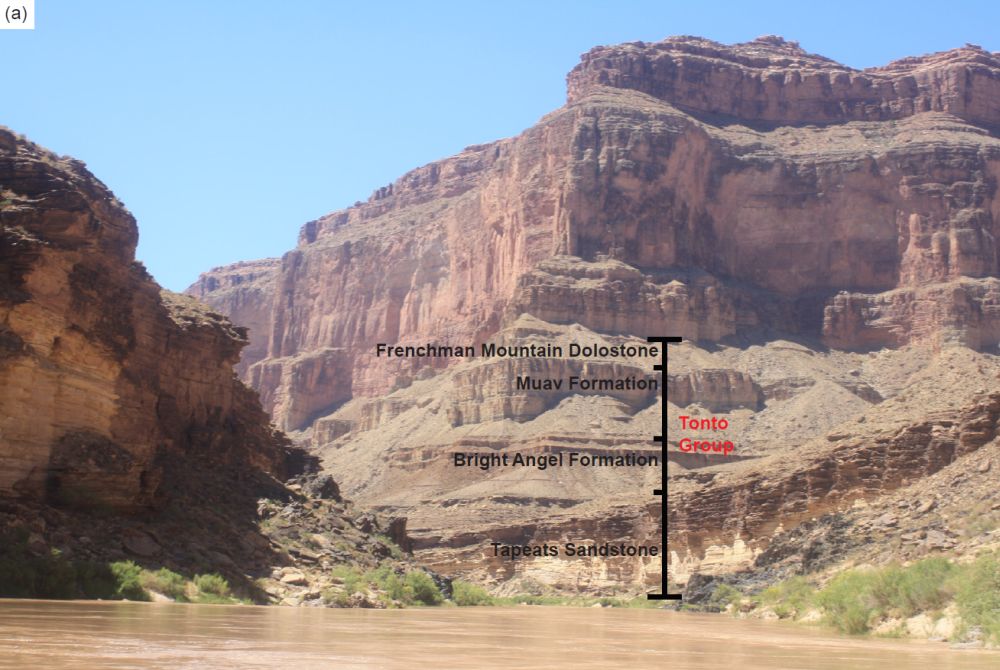
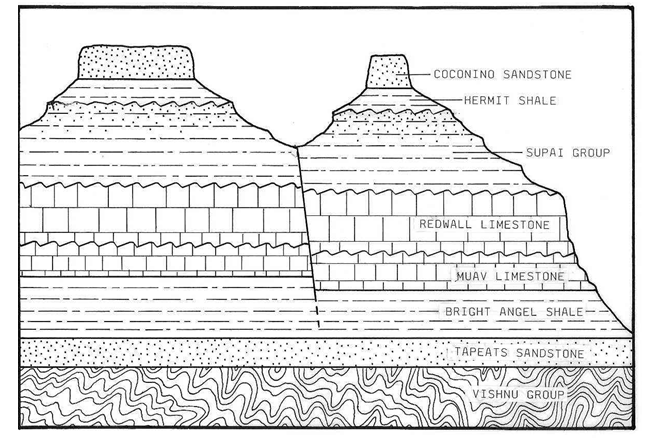
Old Earth geology dates this layer back some 500 to 550 million years, with its origin being very slow tidal deposition (that model, by the way – the very slow layering of geologic strata – is losing popularity among even old Earth geologists). One problem with the old Earth paradigm: The Tapeats Sandstone formation, as mentioned, is folded in places.
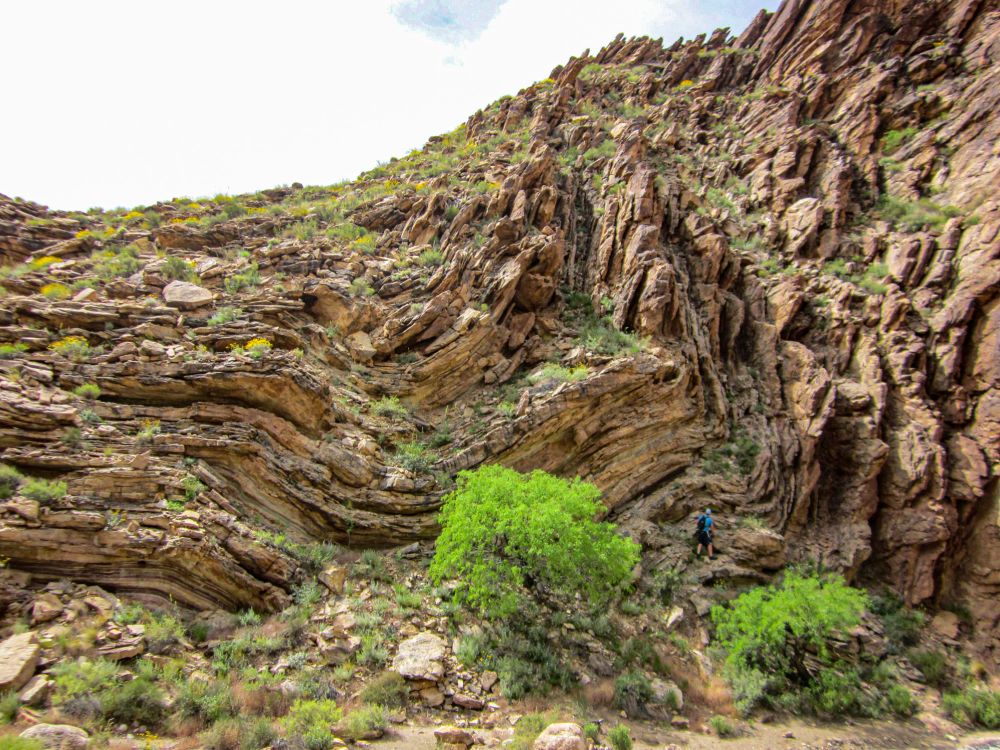
If the Tapeats formation was laid down over the course of tens of millions of years, and more than a half-billion years ago, how, then, do we explain the folding of the layers?
In the past, two basic models have been put forward by old Earth geologists: Either the Tapeats was subjected to high pressure and temperature, which gave the layer elasticity, allowing it to bend to the forces creating the stress; or, the Tapeats, under great stress, folded by way of very small cracks, very slowly over millions of years.
The former model would allow for a more fluid-like appearance to the layering, whereas the latter would present a fragmented appearance. In either case, the evidence as to what caused folding (stress cracks or elastic bending) would be visible only under a microscope.
Recently, research into the folding of the Tapeats has revealed what those folded layers look like under microscopic inspection, including a scanning electron microscope which allows for a detailed 3-D representation of the sediments and their cementing agents. What were the results of the study?
The folded areas of the Tapeats Sandstone in the Grand Canyon are indistinguishable from the flat areas of the Tapeats in identical layers located miles away from the folds.
They’re identical!
Were the high heat/pressure model in play, the rock would have undergone metamorphic processes that would be readily apparent – very evident – under the microscope. No such hint of such metamorphic processes are visible in the Tapeats folds. Likewise, absolutely no cracking/fracturing is visible. Under the 3-D imagery of the scanning electron microscope, the Tapeats grains are well-cemented and (quite astonishingly) undisturbed since the time of their cementation.
What’s the big deal? Why is that astonishing? Because the old Earth model of how lithified sediments fold goes like this: Sedimentation-lithification-folding. The sediment is laid down, cementing agents are in solution with the sediments, water is removed, and the sediments lithify. After that, folding occurs, either by fracturing or elastic bending.
What the scanning electron microscope reveals is not just what the rock looks like now, but the process of how that rock came to be folded: Sedimentation-folding-lithification. The sediments were laid down, the folding occurred (before the sediment had time to cement!), and then the layers were lithified.
The processes that formed the Tapeats Sandstone formation that covers much of North America (and reaches into Greenland) cannot have formed as old Earth geologists have modeled because (primarily) the layers folded before lithification.
One other compelling fact about the folds that are visible in Grand Canyon geologic formations: They can include more than one geological feature (see photo below).
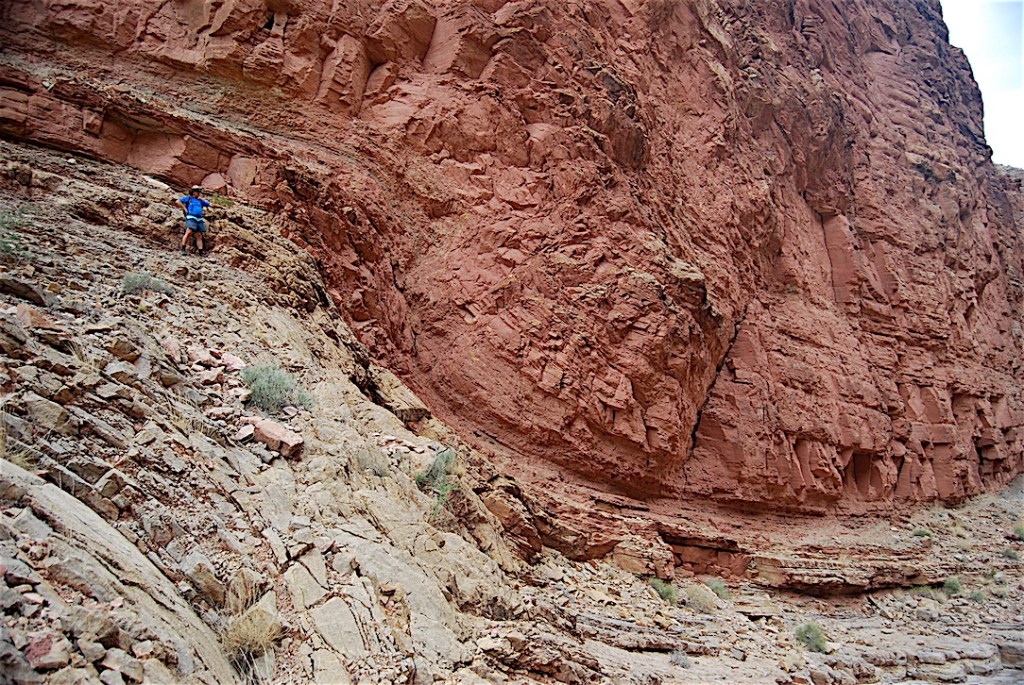
If layers folded without cracking/fragmentation, and without the metamorphic evidence of heat & pressure; and, if layers folded prior to lithification; and, if every layer in one formation, as well as every layer through multiple geologic formations, all folded in the same way, then those layers all bent prior to hardening into rock. Were an old Earth geology model in play, then all of those many layers would have had to have been held in some inexplicable state of pre-lithification for hundreds of millions of years, then experienced the folding, and then suddenly lithified. That’s a lot to ask of a model!
Would now be the time to drop the model of a very old Earth? Aren’t the gymnastic-like responses to such insurmountable evidences that counter the multi-million year models becoming embarrassingly evident? For decades geologists have been excoriated by the scientific community for daring to publish papers that suggest catastrophic events shaped large geologic features, not millions of years of slow processes.
One such scorned scientist was J. Harlen Bretz, who was repeatedly marginalized and ridiculed for his models of how the Channeled Scablands of the American northwest formed – Until he was awarded the Penrose Medal (the Geological Society of America’s highest award) in 1979 when he was 96 years old. Sidebar: Bretz is alleged to have told his son, “All my enemies are dead, so I have no one to gloat over.”
How many talented scientists out there, like Bretz, will continue to be mocked for daring to publish works that bring light to the worst aspects of old Earth models? For how much longer will the words of atheist Richard Dawkins (speaking of what people should do to creationists, “Mock them.”) meet the applause of the popular scientific world? When will the stark reality that the Grand Canyon formed suddenly be accepted?
Well, friend, the research commented upon here, conducted by Dr. Andrew Snelling, is monumental in ramification, and must be faced squarely by old Earth scientists as a Bretz-like moment in the advancement of geology. See the most-recent publication of Dr. Snelling here:
https://answersresearchjournal.org/geology/monument-fold-grand-canyon
Isn’t it time to drop the cumbersome chains of the old Earth model? Drop that paradigm; drop it like dimes into the wishing well of naturalistic explanations. Because it’s becoming evermore clear that the geologic models of the Earth (and all other sciences) line up best with the historic and literal accounts of Creation, the Flood, and the human dispersion from Babel as recorded in the Bible.
I invite you to read so much more about this topic at these excellent websites:
https://answersresearchjournal.org/
They’re but a few of the outstanding sources of scientific research within an admittedly Biblical paradigm. Oh, and I’m keeping my twenty cents!
Happy reading!
“But they deliberately forget that long ago by God’s word the heavens came into being and the earth was formed out of water and by water. By these waters also the world of that time was deluged and destroyed.”
2Peter 2:5-6 NIV, 2011
 Genuine Genesis - Reclaiming human value through God's Word