

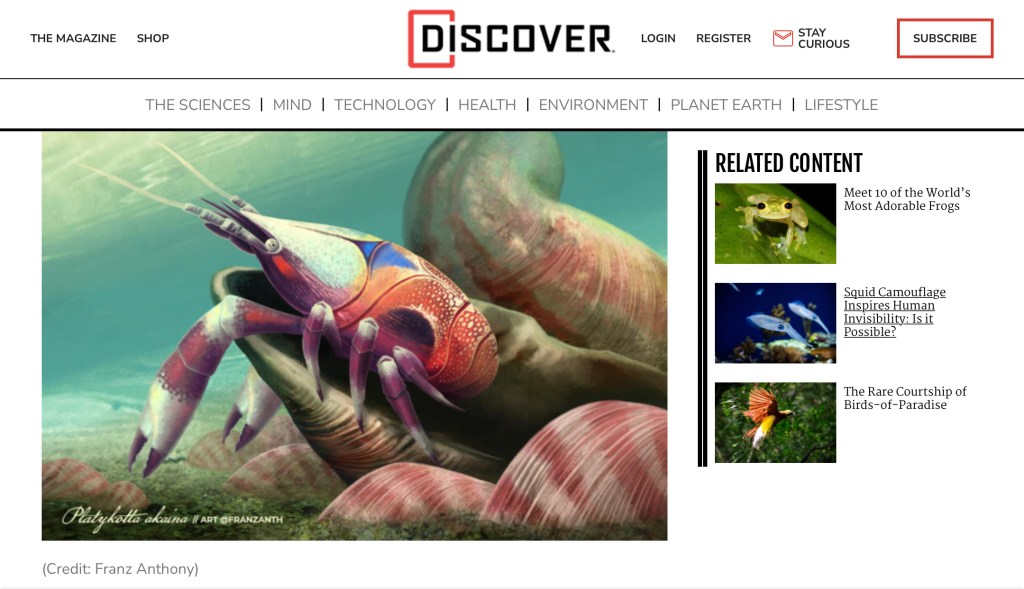
The debate continues among secular scientists who seek to resolve the mystery as to why so many crab varieties exist by placing the question within the context of evolution. Their quest is futile. Crabs didn’t evolve. In fact, nothing evolved. But, “science” as it presents itself today ignores the most basic fact about their favored theory of origins: There is no theory of origins.
I finished undergrad, and then did my graduate program, at a B&M university between 2009-2013. Fairly recent, I’d say. I chose to purchase physical textbooks as opposed to buying e-copies. My degrees are in the sciences.
I say all of that to say this: In my experience within the American education system, and having completed successfully seventeen years therein & having been awarded BS and MS degrees, I never once heard a lucid explanation of origins.
If evolution occurred, then we (all living things) are the product of an accidental colocation of atoms that resulted in the first living cell. That organization – that first cell – should have a well-structured explanation as to how it came to be.
Chapter 18 of Sylvia Mader’s college textbook “Biology” is titled, “Origin and History of Life” and the chapter stretches from pages 317 to 336 in her 900+ page tome. Concerning the origin of living things, on page 318 Mader writes “Since it was the very first living thing, it had to come from nonliving chemicals.”
That sentence is as close to an explanation as there is.
Others who have this textbook may argue that Mader provides several theories as to how life did emerge. But, none of those provide a logical and supportable model; they’re simply guesses. A recap of her chapter provides this: ‘Abiotic synthesis created organic molecules that joined together to form proteins, which aggregated within a membrane and (once that membrane contained DNA) a true cell had formed.’
Mader ignores the problem of how abiotic synthesis might achieve those ends. She offers nothing to support her opening statement that “it had to come from nonliving chemicals” or her conclusion “Once the protocell contained DNA genes, a true cell had emerged.” Instead, Mader provides a lot of eye candy and unsubstantiated evolutionary doctrine.
Chapter 18 uses nearly all of the twenty pages allotted to provide imagery and charts explaining the variations of life on Earth, and includes a diagram and recap of the Miller-Urey experiment. That, in itself, is a shocking mystery, since even secular and non-theist scientists have long-considered Miller-Urey as highly problematic.
Among the many issues with their experiments, Miller-Urey filtered out all destructive frequencies of light so that they could not break up the formation of organic chains. Also, they trapped and isolated their pre-targeted “results” from the more than 99% of “other” material their experiments formed before those materials could destroy the targeted chains.
Finally, regarding Miller-Urey, saying that the accidental formation of an amino acid proves that life emerged from non-life is very much akin to saying that, since metals are found in newly-formed volcanic rock, it proves that 747s evolve from volcanism. Actually, the most “simple” single-celled organism is vastly more complex than any jet aircraft. So, even THAT analogy fails to provide the correct scope of the problem of life emerging from non-life.
The past twenty-plus years of microbiological research has, on the other hand, demonstrated clearly the mind-boggling complexity of single-called organisms and the DNA they contain. Bader’s statement that cells formed when proteins were created within a membrane ignores all of that vast complexity, and also sidesteps the fact that a cell’s membrane is ALSO a complex array of lipids and proteins in precisely the right configurations, and (of course) more DNA.
These problems, and many others regarding the emergence of life from non-living material, are papered over with statements like those found in Bader. In attempting to reconcile the problem of which came first, the DNA molecules that codes for proteins or the proteins that read and translate the DNA molecules, Bader writes “It is possible that this sequence developed in stages.” That’s it! Phrases like these exist as the “magic wands” of evolution: Wave the wand over the tricky parts of discussions about origins, and move immediately on to other evolutionary models (all of which begin with life already in place).
Another issue for naturalistic origins is the absence of attempts to create proteins. If proteins arose by purely chance collocation atoms, then here’s the numeric problem: To assemble one (just ONE) protein from the material available on the Earth, chance (the agent constructing the protein) would require 1 X 10 to the 164th power attempts. The number is unimaginable. In fact, it is far, far beyond what mathematicians consider absurd, which the general consensus is that absurdity occurs at around 10 to the 50th.
Again, one possibility among 10 to the 164th combinations of linking together a protein.
So, two questions emerge: 1) Where are all of the trillions and trillions of attempts, and 2) Why are we not seeing trillions and trillions of attempts being made today? If evolution is a result of blind chance, then chance should be still furiously attempting to piece together molecules to form an amino acid, and piecing together amino acids to form proteins, and piecing together proteins to form cells. Why would it ever stop? Blind chance cannot “know” that it has succeeded; it cannot know anything.
So, where is all of that activity occurring? One might speculate that there is a flurry of chemical activity in, for instance, the vicinity of hot oceanic water plumes. Saying that there is chemical activity in their presence is not at all the same thing as showing that the waters around those plumes contain a trillion-trillion-trillion-trillion attempts at piecing together an amino acid chain that leads to a protein molecule. I’m understating how wide the gap is between those two process (or the evidences for those processes).
If the accidental arrangement of molecules to form a protein ever did happen (which it did not), if it ever could happen (which it cannot), you’d have a single protein floating in a sea, or in an atmosphere, on on the ground, exposed to multiple processes by which that protein molecule would be quickly destroyed. Take another step forward in the argument, and in order to have a working cell, you need hundreds of different types of proteins, and millions of total proteins, all within a cell membrane whose existence is also impossible to explain. Such an occurrence would be absurdly absurd to the nth power.
And, so, I’ll return to the article linked at the outset of this essay, and to it’s arguments regarding how and why multiple crab species emerged in the framework of evolution. The real problem is that to even have this argument is to ignore the empty spot on the shelf where the Emergence of Life model should be. Right now, worldwide, thousands of scientists and graduate students, post-grad students, post-doctoral researchers, and so on, struggle with questions like the crab dilemma. Yet, what they should be working on is that empty spot on the shelf.
No argument on how various aspects of the evolutionary model works is valid until the process by which a living cell emerged from random, non-living matter is elucidated and demonstrated.
I’ll repeat that: No argument on how various aspects of the evolutionary model works is valid until the process by which a living cell emerged from random, non-living matter is elucidated and demonstrated.
There can be no such evolutionary framework without a foundation built from the explanation of how the undirected chance emergence of life occurred from non-living matter.
What, then shall we say? Is there any explanation for life? Yes, there is an explanation. The very first verse in Scripture, Genesis 1:1, says
“In the beginning God created the heavens and the earth.”
That is not fantasy, and it is not a fairy tale. In fact, Almighty God re-asserts the fact numerous times, as in Exodus 20:11 where He says,
“For in six days the Lord made the heavens and the earth, the sea, and all this is in them, but He rested on the seventh day.”
God created all life. He engineered in an instant the vast complexity we see everywhere, from the tiny living cell to an incomprehensibly huge universe filled with galaxies, stars, and planets. God created it. In this statement we find no need for a model of how life emerged by chance from non-life; we have no need to account for multiple species of crabs, or any other organism.
God created all life, and that’s the answer to the question “How did life emerge?”
God ordained living things to reproduce after their own kind, and He made numerous crab-like animals that reproduce after their own kind. That answers questions to wit, “Why are there multiple species of crabs.”
Discover magazine, and author Jason P. Dinh, would do well to accept those answers, as would scientists everywhere. And, they would serve more completely all of mankind if they were to devote their energy & intellect to showing the non-scientific citizens of planet Earth just how amazing is the creative power of our awesome God!
“But ask the animals, and they will teach you,
or the birds in the sky, and they will tell you;
or speak to the earth, and it will teach you,
or let the fish in the sea inform you.
Which of all these does not know
that the hand of the Lord has done this?
In His hand is the life of every creature
and the breath of all mankind.
– Job 12:7-10
Postscript: For more information, and for thousands of scientific articles on the failings of the theory of evolution, go to Creation.com and type “evolution” into the search engine. Happy reading!
All Scriptures from THE HOLY BIBLE, NEW INTERNATIONAL VERSION®, NIV® Copyright © 1973, 1978, 1984, 2011 by Biblica, Inc.™ Used by permission. All rights reserved worldwide.
Bader quotes from BIOLOGY, TENTH EDITION, McGraw-Hill/Irwin, New York, NY. Copyright 2010.
 Genuine Genesis - Reclaiming human value through God's Word